
For the first time, an AI agent independently completed a purchase and paid for it using BLIK, without the user’s involvement at the moment of the transaction.
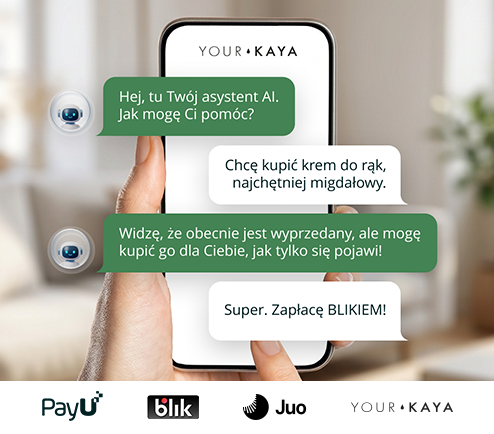
As part of the pilot project, the agent monitored the availability of a product specified by the user during a conversation with an AI assistant in the Your KAYA online store. When the selected product variant – a “light hand cream with coconut and almond fragrance” – became available again, the agent made the purchase. The PLN 19.99 transaction was carried out based on a prior instruction given to the agent, confirmed by entering a six-digit BLIK code and approving it in the user’s banking app. Juo was responsible for enabling the AI agent chat in store, while the payment was processed by PayU.
The autonomous BLIK payment pilot demonstrates that AI agents can securely use BLIK to make purchases on behalf of users, within boundaries defined by them in advance. It also confirms that the technology across every stage of the process – from AI infrastructure, through the merchant environment and payment processing, to the payment method itself – is ready today to support systems capable of completing purchases without the consumer’s direct involvement.
“The market is seeing a growing number of solutions capable of finding products, comparing offers and recommending the best way to buy. Until now, payment has been the missing element in this process. Our solution completes the model: an agent can take over the entire purchasing journey, from monitoring an offer to finalising the transaction with BLIK. However, it operates exclusively within boundaries previously defined by the user and cannot complete a transaction without the user’s prior authorisation,” emphasises Monika Król, Vice President of BLIK. “For us, however, the significance of this pilot goes far beyond the agent’s ability to make a payment. It is a test of whether Poland’s payment infrastructure – available today in virtually every banking app and accepted by thousands of online stores – can become the foundation of an entirely new purchasing model. Agentic commerce changes the definition of who the buyer is, and the payment systems that succeed will be those that are ready for this shift before it becomes a market standard. We want BLIK to be one of them,” she adds.
In traditional e-commerce, users independently move through each stage of the purchasing journey – searching for a product, checking its availability, adding it to the basket, selecting a payment method and authorising the transaction. In commerce involving AI agents, some of these activities can be delegated to technology. An agent can help identify suitable products, but it can also complete a purchase according to the model selected by the user – whether as a one-off transaction carried out immediately with the customer’s involvement, a one-off transaction executed at a later time on the customer’s instruction (for example, when a size is unavailable, an item is out of stock or delivery needs to be postponed), or as an instruction for subscription of selected products.
“Agentic commerce will not transform retail simply because an agent is able to buy something. The real change will begin when it understands the customer’s context, the relationship with the merchant, the user’s consents and the way payments are executed. At Juo, from the very beginning, we have been building technology with a full understanding of the long-term customer relationship. That is why this pilot is so important to us: it shows not only the future of payments, but also what subscriptions could look like in the world of agentic commerce,” says Leszek Zawadzki, CEO of Juo.
In the pilot, a logged-in user initiated the process through a chat conversation and assigned tasks to the AI agent. Its objective was to monitor the availability of a hand cream whose selected variant was sold out at the time. The agent continuously checked the store’s offer, waiting for the specified product to become available again.
A key element of the process was the user’s prior instruction authorising the agent to complete the purchase and execute the payment. The user granted payment consent in their banking app, defining the conditions under which the agent could continue acting on their behalf.
“The first payment completed by an AI agent without the user’s direct involvement confirms that agentic commerce is moving beyond the conceptual stage and is becoming a real purchasing scenario. Crucially, however, agent autonomy does not mean that consumers lose control – the agent operates within the limits of previously granted payment consent, defined spending limits and clearly specified conditions. At PayU, we are committed to developing solutions that will allow agent-driven purchases to scale responsibly, because their success will depend not only on technology, but above all on customer trust,” says Katarzyna Prus-Malinowska, Head of Product Management at PayU.
When the product became available again, the AI agent detected its availability, added the previously specified variant to the basket and independently completed the entire process. The PLN 19.99 purchase was paid for using BLIK. At the moment the transaction was finalised, no additional action was required from the user – the agent acted autonomously within the boundaries of the payment consent previously granted in the banking app.
“Whenever a technology emerges that can make shopping more convenient for our customers, we want to be among the first to test it. That was the case with subscriptions paid for using BLIK recurring payments. Today, together with Juo, BLIK and PayU, we are the first in Poland to open the chapter of agentic commerce: shopping experiences in which customers are supported by an intelligent assistant,” says Dawid Zimny, Head of Growth & eCommerce at Your KAYA.